

1. Introduction
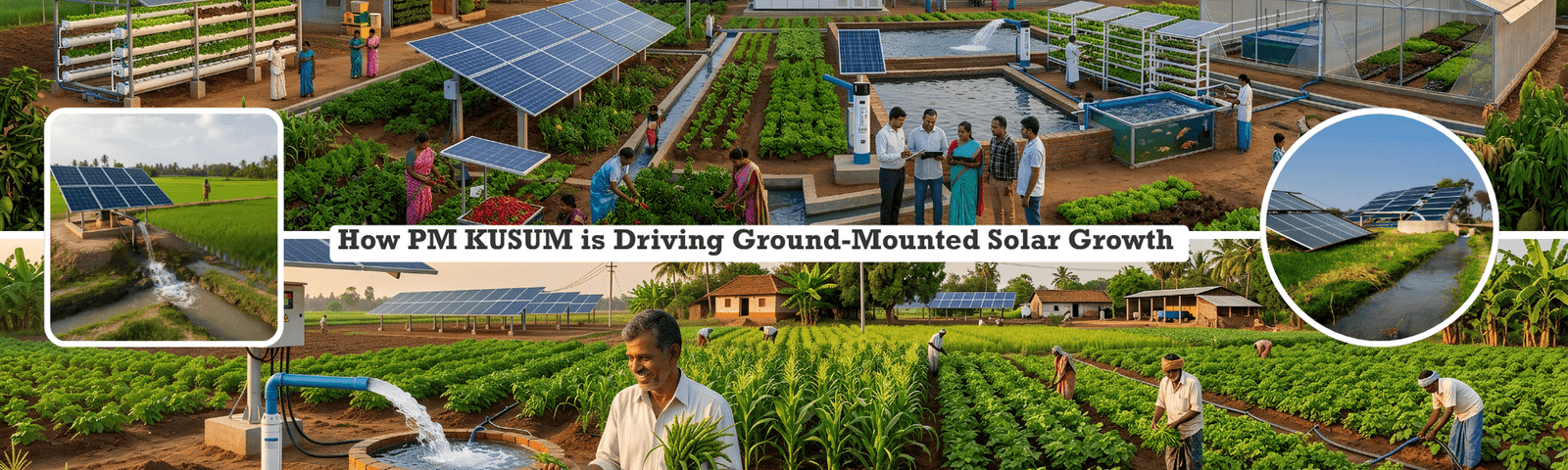
India’s renewable energy sector is expanding rapidly, and solar power is playing a major role in this transformation. Among the various government initiatives supporting clean energy adoption, the PM KUSUM Yojana has emerged as one of the most impactful programs for promoting solar energy in rural and agricultural sectors.
The scheme is not only helping farmers access cleaner and more affordable electricity but is also significantly increasing the demand for ground-mounted solar systems across the country. From agricultural solar pumps to decentralized solar plants, PM KUSUM is creating new opportunities for solar developers, EPC companies, and solar structure manufacturers.
As India moves toward sustainable energy independence, the scheme is becoming a strong driving force behind the growth of ground-mounted solar infrastructure.
2. What is PM KUSUM Yojana?
PM KUSUM (Pradhan Mantri Kisan Urja Suraksha Evam Utthaan Mahabhiyaan) is a government initiative launched to support solar energy adoption in the agricultural sector.
The scheme mainly focuses on:
The goal of PM KUSUM is to improve farmers’ energy accessibility while promoting renewable energy generation in rural India.
3. Understanding Ground-Mounted Solar Systems
Ground-mounted solar systems are solar panel installations set up on open land using specially designed mounting structures instead of rooftops.
These systems are widely used for:
Ground-mounted systems are ideal for PM KUSUM projects because they can be installed near agricultural lands and rural power distribution points.
4. Why PM KUSUM is Important for India’s Solar Future
India has a large agricultural sector with significant electricity consumption for irrigation and farming activities. Traditional power sources often create financial and environmental challenges due to rising fuel costs and inconsistent electricity supply.
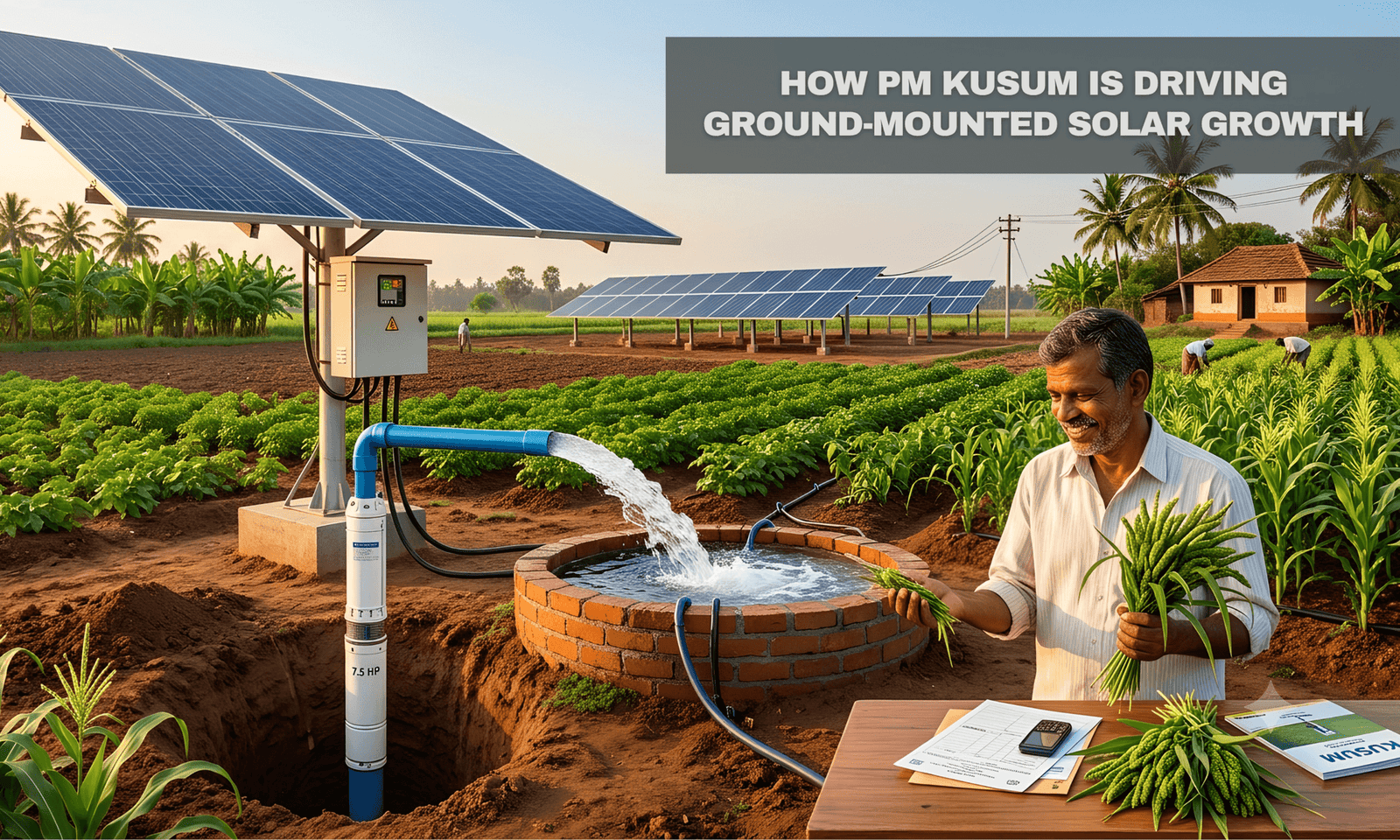
PM KUSUM addresses these issues by encouraging decentralized renewable energy generation. As a leading PM solar scheme, it enables farmers to generate solar energy locally and use it for irrigation and farming operations Instead of depending entirely on conventional electricity sources, farmers can generate solar energy locally and use it for irrigation and farming operations.
This not only supports clean energy adoption but also contributes to India’s larger renewable energy goals.
5.How PM KUSUM is Accelerating Ground-Mounted Solar Growth
Increasing Demand for Solar Installations
The scheme has created large-scale demand for ground-mounted solar projects in rural and agricultural regions. Thousands of solar-powered installations require durable mounting structures and reliable solar infrastructure.
Expansion of Decentralized Solar Plants
PM KUSUM encourages the installation of decentralized solar power plants near substations and agricultural lands, increasing the need for land-based solar systems.
Growth in Rural Renewable Infrastructure
Ground-mounted solar systems are becoming essential for powering irrigation systems, farming operations, and rural electrification projects.
Encouraging Private Sector Participation
The scheme has opened opportunities for EPC companies, solar developers, structure manufacturers, and renewable energy suppliers to participate in rural solar expansion.
6. Benefits of Ground-Mounted Solar Under PM KUSUM
The PM solar scheme offers multiple benefits for farmers and rural communities, including:
Better Land Utilization
Unused or less productive land can be utilized for solar energy generation, creating additional income opportunities for farmers.
Reliable Energy Supply
Solar-powered irrigation systems provide farmers with dependable electricity during daytime farming operations.
Lower Operating Costs
By reducing dependence on diesel pumps and rising electricity tariffs, solar systems help lower long-term farming expenses.
Scalable Solar Infrastructure
Ground-mounted systems can be expanded easily depending on future energy requirements.
Sustainable Energy Generation
The scheme promotes clean energy production while reducing carbon emissions and fossil fuel dependency.
7. Impact on Farmers and Rural Communities
PM KUSUM is creating positive economic and social impact in rural India.
Farmers benefit through:
The scheme is also generating employment opportunities in solar installation, manufacturing, project execution, and maintenance services across rural regions.
8. Role of Solar Structures in PM KUSUM Projects
Ground-mounted solar structures play a critical role in the success of PM KUSUM installations. These structures support solar panels securely while ensuring optimal tilt angles and long-term durability.
Since agricultural and rural environments can face extreme weather conditions, solar structures used in PM KUSUM projects must be:
Strong mounting structures help improve the performance and reliability of solar projects for decades.
9. Challenges in Implementing Ground-Mounted Solar Projects
Despite its advantages, implementing this PM solar scheme also faces certain challenges.
Land and Site Selection
Proper land identification and site preparation are important for successful installation.
Infrastructure and Logistics
Transporting solar components to remote rural locations may require additional planning.
Technical Awareness
Many rural users require guidance regarding system operation and maintenance.
Project Coordination
Large-scale implementation requires coordination between government agencies, developers, suppliers, and local stakeholders.
However, continuous policy support and growing solar industry participation are helping overcome these challenges.
10. Future of PM KUSUM and Solar Infrastructure in India
The future of PM KUSUM appears highly promising as India continues expanding renewable energy capacity.
With increasing emphasis on:
Ground-mounted solar systems are expected to witness substantial growth in the coming years.
The scheme is likely to continue driving investment in solar farms, decentralized energy systems, and solar mounting infrastructure throughout India.
11. Conclusion
PM KUSUM is playing a transformative role in India’s renewable energy journey by encouraging solar adoption in the agricultural and rural sectors. The scheme is not only improving farmers’ access to reliable energy but is also accelerating the growth of ground-mounted solar infrastructure across the country.
As demand for decentralized solar systems increases, ground-mounted solar projects and durable solar structures will continue becoming essential components of India’s clean energy expansion.
By combining sustainability, rural development, and renewable energy generation, PM KUSUM is helping build a stronger and greener energy future for India.
12. FAQ’S
PM KUSUM is a government scheme that promotes solar energy adoption in the agricultural sector through solar pumps and decentralized solar power plants.
The scheme encourages large-scale installation of land-based solar systems for irrigation and rural energy generation.
Ground-mounted systems are ideal for agricultural and rural areas because they can be installed on open land and scaled easily.
Farmers benefit through lower irrigation costs, reliable electricity, reduced diesel use, and sustainable energy generation.
Solar structures provide stability, support, and correct panel positioning for efficient energy generation.
Yes, by replacing fossil fuel-based energy sources with solar power, the scheme supports cleaner energy generation.
Solar manufacturers, EPC companies, mounting structure suppliers, installers, and renewable energy developers benefit from the scheme.
With growing renewable energy demand and rural electrification goals, PM KUSUM is expected to continue driving solar infrastructure growth across India.