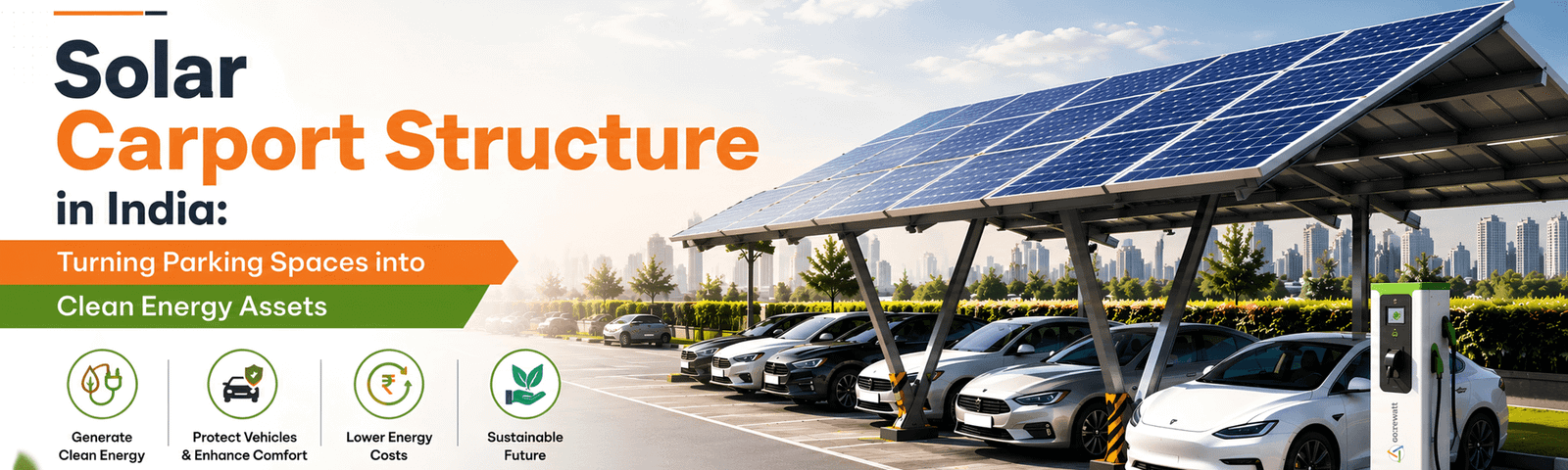
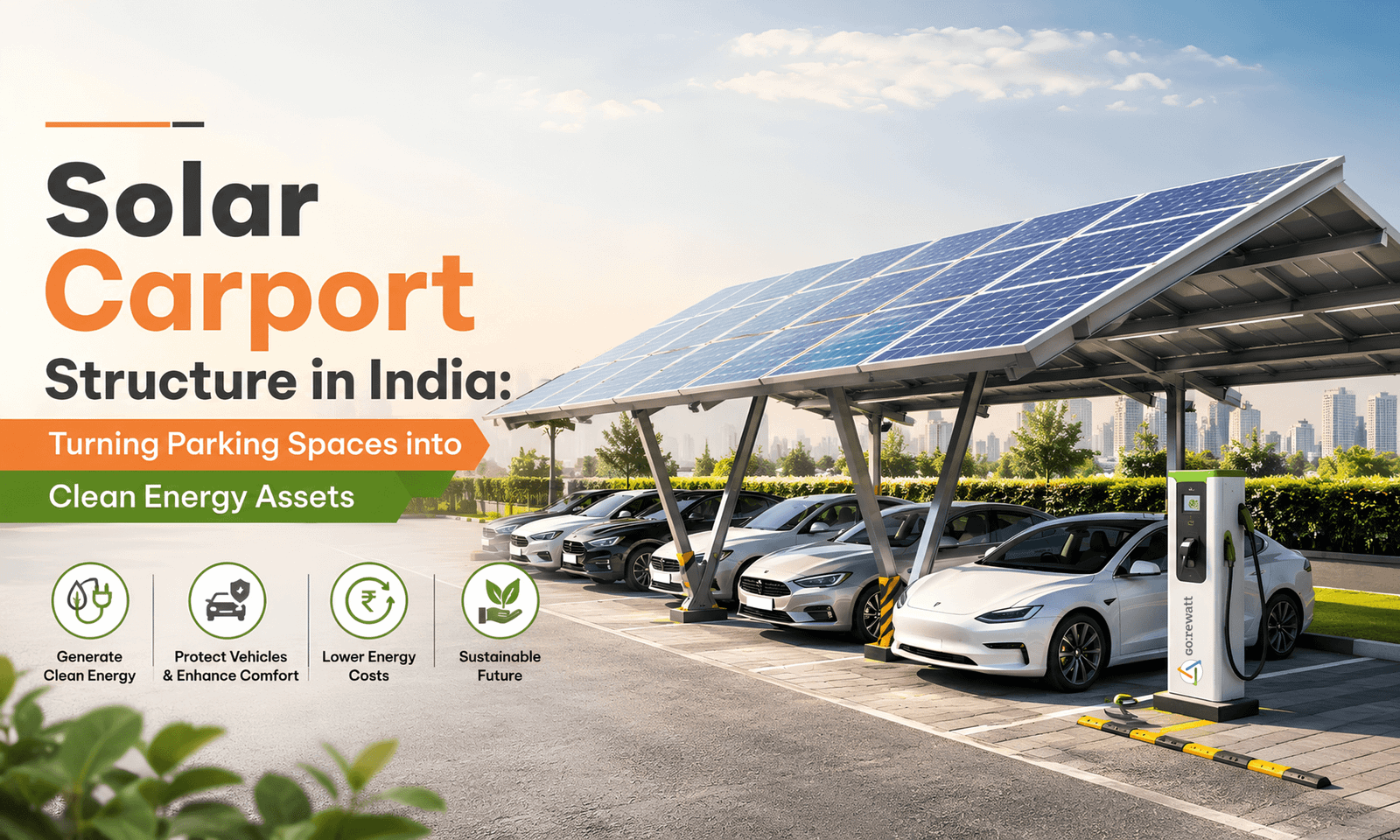
What if a parking area could do more than hold vehicles?
What if it could generate solar energy, support EV charging, provide shade to the vehicles and make optimal use of the existing space.
Solar carport structure in India bring these benefits together by turning parking areas into productive energy assets.
As businesses and institutions look for practical ways to reduce energy costs and improve sustainability, solar carports offer a smart solution.
1. What is a Solar Carport?
A solar carport combines a parking shelter with a solar power system.
The structure sits above the parking area. Solar panels cover the canopy and generate electricity from sunlight. At the same time, the canopy protects vehicles from direct sunlight and weather.
Unlike a rooftop system, a carport uses a dedicated structure. Therefore, it can serve locations that may not have enough suitable roof space.
A well-planned solar carport structure in India should support the panels, handle local weather conditions, and connect effectively with the facility’s electrical system.
In this way, one structure serves two purposes: vehicle protection and clean power generation.
2. Why Solar Carports Make Sense
Solar carports combine several benefits in one installation.
They use existing parking areas. They generate electricity where it is needed. Moreover, they can support EV charging and other sustainability initiatives.
For businesses and institutions, this creates an opportunity to turn unused overhead space into a productive asset.
3. No Additional Land Required
One of the main advantages is the optimal use of the land.
The parking area already exists. Vehicles already use the space. Therefore, the system can do solar generation without needing a separate field or area.
This approach works particularly well in urban areas where land is limited or expensive.
Factories, offices, malls, hospitals, and commercial complexes can therefore add solar capacity while keeping their existing parking areas functional.
4. Shade and Vehicle Protection
Indian summers can expose parked vehicles to intense heat.
A solar canopy creates shade and helps reduce direct heat exposure. Consequently, vehicles can remain more protected when parked for long periods.
The canopy can also provide protection from:
Furthermore, reducing direct heat and sunlight can help protect vehicle interiors and surfaces over time.
5. On-Site Clean Electricity
A major benefit comes from generating electricity directly at the point of use.
Solar panels can supply power to the facility during daylight hours. As a result, businesses can use solar generation to offset part of their daytime electricity demand.
Factories, offices, schools, hospitals, malls, and other facilities can use the generated power for their regular operations.
Because generation happens on-site, the system can also reduce dependence on electricity supplied through the grid.
6. Cost Savings
Solar power can help businesses reduce their electricity expenses.
After installation, the system generates electricity from sunlight without ongoing fuel costs. Therefore, each unit of solar electricity used on-site can contribute to long-term energy savings.
Actual savings and payback depend on factors such as:
Consequently, businesses should evaluate the complete project economics before installation.
7. EV Charging Integration
EV adoption continues to create demand for accessible charging infrastructure.
Since the vehicles are already parked below the solar panels, the solar carport provides an ideal location for EV.
The generated electricity can support charging during the day. Additionally, battery storage can facilitate energy use as & when needed.
For businesses, hotels, offices, malls, and fleet operators, combining solar generation with EV charging can also create an additional customer or employee amenity.
8. Rainwater Harvesting Potential
A carport canopy can also collect rainwater.
With suitable gutters and drainage, businesses can channel rainwater into storage systems. They can then reuse the collected water for landscaping, cleaning, toilets, or selected industrial applications.
Therefore, a properly planned carport can support more than energy generation. It can also contribute to broader water management goals.
9. Enhanced Property Value
A modern solar carport can make a visible sustainability statement.
It demonstrates a commitment to renewable energy and responsible resource use. Moreover, it can improve the experience for employees, customers, and visitors by providing covered parking.
For businesses pursuing sustainability goals, the installation can also support their broader environmental initiatives.
10. Where Are Solar Carports Used?
Solar carports work well wherever large parking areas meet significant energy demand.
Manufacturing Units and Industries
Factories often have large employees and logistics parking areas. Solar canopies can use these spaces while supporting high daytime energy consumption.
Malls and Retail Centers
Large parking areas provide significant space for solar generation. At the same time, customers receive shaded parking.
Educational Institutions
Schools, colleges, and universities can use carports to support clean energy goals and sustainability initiatives.
Airports and Transport Facilities
Large parking areas can provide extensive installation opportunities. In addition, solar generation can support the substantial energy requirements of these facilities.
Corporate Campuses
IT parks and business campuses can combine covered parking with renewable energy generation. They can also integrate EV charging for employees and visitors.
Stadiums and Event Venues
Large parking areas can support solar generation even when events are not taking place.
Hotels
Hotels can use covered parking as an added guest amenity while generating renewable electricity for their operations.
Fleet operators, logistics companies, delivery businesses, and cab operators can also benefit.
They facilitate a more holistic system by combining battery with solar energy generation and EV charging
11. Solar Carport Maintenance
Solar carports require regular maintenance to maintain reliable performance.
Routine maintenance should include:
Dust can accumulate quickly in many Indian locations. Therefore, regular cleaning remains important for maintaining solar generation.
Similarly, periodic structural inspections can identify loose connections, corrosion, or other issues before they become major problems.
12. Types of Solar Carports
Different parking layouts require different structural configurations.
Single-Post Cantilever
One column supports a parking bay. This design can provide an open parking area with fewer obstructions.
T-Post Structure
A central support can serve two parking rows. Therefore, this configuration can make efficient use of structural materials.
Multi-Bay Structure
Multiple columns cover larger parking areas. This option can suit malls, airports, factories, and stadiums.
Flat or Low-Tilt Structure
These structures use a lower panel angle. They can offer a clean and compact appearance.
Pitched or High-Tilt Structure
A steeper angle can support rainwater runoff and may suit specific project requirements.
EV-Integrated Structure
This configuration combines solar panels with EV charging points. As a result, businesses can connect renewable energy generation with electric mobility.
The right solar carport structure in India depends on parking layout, available space, wind conditions, panel configuration, electrical requirements, and project objectives.
13. Conclusion
Parking areas occupy valuable space. However, they can do much more than store vehicles.
A solar carport can provide shade, generate clean electricity, support EV charging, enable rainwater collection, and contribute to long-term energy savings.
As electricity demand grows and EV adoption increases, businesses can use their existing parking infrastructure more efficiently.
Therefore, solar carport structure in India can become a practical solution for organizations that want to combine renewable energy, smarter infrastructure, and better land utilization.
With the right planning, engineering, installation, and maintenance, parking can become an active part of a clean energy strategy.