
Solar energy can help you lower electricity costs and use cleaner power. However, solar panels do not directly supply the type of electricity most appliances need. The inverter fills this gap.
It converts the DC generated by solar panels into AC for use. Your appliances can then use this electricity. In addition, the inverter can manage energy flow, monitor system performance, and provide important protection.
Whether you are planning a residential or commercial installation, the right choice can improve efficiency, reliability, and long-term value.
This guide covers the key points you should consider before buying a solar inverter for home or business applications.
1. What Does a Solar Inverter Do?
Solar panels generate DC electricity. Most household and commercial appliances, however, operate on AC electricity. The inverter bridges this gap.
It changes the electricity from DC to AC so your appliances can use it. At the same time, some advanced inverters can manage batteries and grid electricity.
As a result, the inverter becomes an important part of the complete solar setup. Its functions can include energy conversion, system monitoring, grid management, and electrical protection.
2. Why Does Inverter Selection Matter?
A solar system needs more than good-quality panels. The inverter also needs to match the system correctly.
A suitable inverter can help you:
Moreover, the right inverter can help you get more practical value from your solar investment.
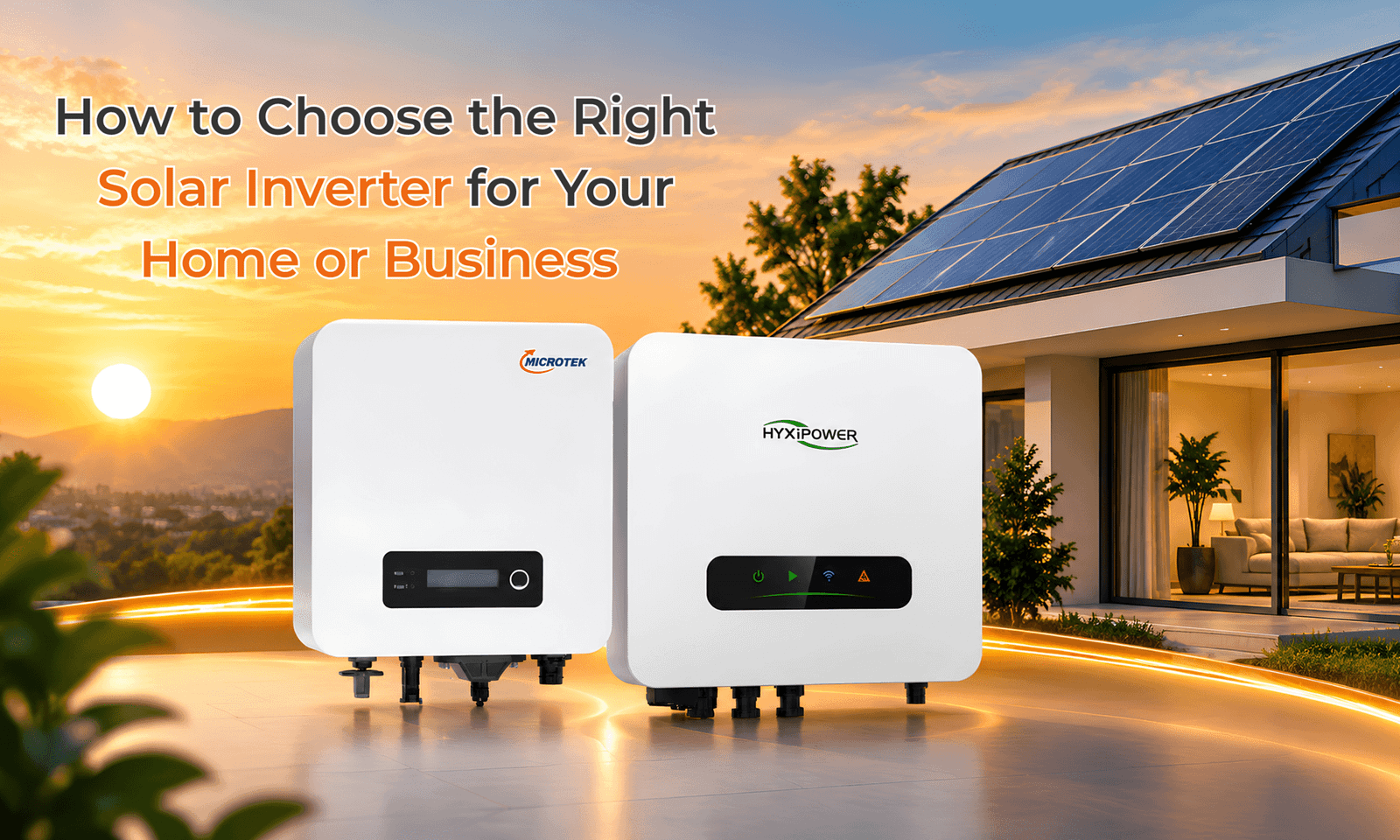
3. Main Types of Solar Inverters
Solar systems have different requirements. Therefore, inverter selection depends on the property, energy needs, and desired system design.
On-Grid Inverter
An on-grid inverter connects the solar system with the utility grid. It converts solar electricity into AC power for use within the property.
Furthermore, it can work with net-metering arrangements where they are available.
However, a standard on-grid system generally stops supplying power during a grid outage. This happens because of safety requirements associated with the utility network.
Off-Grid Inverter
An off-grid inverter operates without depending on the utility grid. It usually works together with batteries.
Therefore, this type can suit properties located in areas with limited or unreliable grid access.
The battery stores energy for later use. This allows the system to continue supplying selected loads when solar generation is unavailable.
Hybrid Inverter
A hybrid inverter combines several energy-management functions in one system. It can work with solar panels, batteries, and the utility grid.
For example, the system can send excess solar energy to a battery instead of wasting or exporting it. Later, you can use the stored energy when solar production drops.
As a result, hybrid systems can offer greater flexibility and backup capability.
Microinverter
A microinverter works with individual solar panels or small panel groups. Unlike a central inverter, it manages solar generation closer to the panel level.
This design can provide detailed panel-level monitoring. It can also work well on roofs where different panels receive different amounts of sunlight.
4. How to Select the Right Inverter
Start with your actual energy requirements. Do not choose an inverter simply because it offers a higher capacity or lower price.
Instead, evaluate:
For a solar inverter for home, consider your household appliances and expected electricity consumption. Also, think about whether you may add more appliances or battery storage later.
For commercial properties, review operating hours, machinery, peak demand, and future expansion plans.
5. Assess Your Electricity Demand
First, understand how much electricity your property consumes.
Review recent electricity bills. Then, make a list of your major electrical loads.
These may include:
Next, identify your peak demand. Some appliances draw more power when they start or operate at full capacity.
Your inverter should handle the expected load without unnecessary strain. However, installing a much larger inverter without a clear requirement can also be inefficient.
Therefore, ask a qualified installer to assess your load profile and match the inverter with your solar system.
6. Compare Efficiency Ratings
Inverter efficiency indicates how effectively the unit converts DC electricity into usable AC electricity.
A higher efficiency rating generally means less energy gets lost during conversion. Therefore, efficiency deserves attention when comparing different models.
However, do not make your decision based on efficiency alone.
Also review:
A balanced evaluation can help you select a more suitable solution.
7. Match the Inverter With System Size
The inverter capacity should match the design of your solar installation.
A small residential system and a large commercial plant will naturally require different solutions. Therefore, consider both your present system and future plans.
For example, if you expect to install additional solar panels later, check whether the inverter can accommodate your planned expansion.
Proper sizing can help maintain stable performance. It can also reduce the possibility of replacing the inverter sooner than expected.
8. Decide Your Backup Power Needs
Do you need electricity when the grid goes down?
If yes, consider an inverter that supports backup operation and battery storage.
A battery stores surplus energy generated by the solar system. You can then use that stored power when solar production is low or the grid is unavailable.
For homeowners, a solar inverter for home paired with suitable battery storage can provide greater energy flexibility.
Businesses may also benefit from backup systems. Reliable backup can help protect essential operations and reduce downtime.
However, you do not always need to back up every appliance. Instead, identify critical loads and design the system around them.
9. Review Safety Features
Safety should remain a major consideration when selecting an inverter.
Depending on the model, useful protection features can include:
Also, verify that the product meets the applicable technical and safety requirements for your installation.
Installation quality matters just as much. Even a reliable inverter may perform poorly if the system design, wiring, or installation is incorrect.
Therefore, work with a qualified solar professional for system design and installation.
10. Check Monitoring Options
Modern inverters can provide useful information about your solar system.
Depending on the model, monitoring tools may show:
This information helps you understand how your system operates. In addition, it can help installers identify potential problems more quickly.
For a solar inverter for home, mobile monitoring can make energy management easier. You can check system performance without needing to inspect the equipment manually.
11. Evaluate Warranty and Service
An inverter can remain part of your energy system for many years. Therefore, look beyond the initial purchase price.
Before buying, check:
Furthermore, choose a supplier that can support you after installation.
Good after-sales service can simplify maintenance and help resolve technical problems faster.
12. Residential vs. Commercial Inverters
Residential and commercial solar systems often have different operating requirements.
Factor | Residential System | Commercial System |
System size | Usually smaller | Often larger |
Main loads | Household appliances | Machinery and commercial equipment |
Backup | Often focused on essential loads | Often supports critical operations |
Monitoring | Simple and convenient | Detailed performance tracking |
Expansion | Based on household needs | Often linked to business growth |
Installation area | Home rooftop or property | Rooftop, ground-mounted, or commercial site |
For residential systems, focus on simplicity, reliability, backup requirements, and easy monitoring.
On the other hand, businesses should give greater attention to scalability, uptime, load management, and system integration.
13. Mistakes to Avoid
Choosing an inverter only because it has a low price can create problems later. Instead, consider the complete value of the product and system.
Selecting the Wrong Capacity
An incorrectly sized inverter can reduce system performance. Therefore, match its capacity with your solar array and electricity demand.
Forgetting Future Expansion
Your energy requirements may increase over time. So, consider future appliance additions, business growth, or extra solar capacity before making your choice.
Ignoring Battery Compatibility
Planning to add storage later? Check battery compatibility before purchasing the inverter.
This step can prevent compatibility issues when you expand your system.
Overlooking Service Support
Technical problems can occur during the life of any electrical system. Reliable service support can make troubleshooting easier.
Skipping Professional Assessment
Every property has different wiring, loads, roof conditions, and energy-use patterns.
Therefore, get a proper site and load assessment before finalizing the inverter.
14. Final Takeaway
A solar inverter does much more than convert electricity. It helps manage the energy produced by your solar panels and can influence the reliability and efficiency of the complete system.
Therefore, begin with your actual energy requirements. Next, compare inverter types, capacity, efficiency, safety features, monitoring options, battery compatibility, warranty, and service support.
Most importantly, do not select an inverter based on price alone.
A properly sized and professionally installed system can deliver better performance over the long term. Whether you are powering a house, office, shop, or industrial facility, choose an inverter that meets today’s requirements while supporting tomorrow’s energy goals.
15. FAQ’S
A solar inverter converts DC electricity from solar panels into AC electricity that most appliances can use.
Start with your electricity consumption, solar capacity, peak load, backup needs, and available budget. A professional assessment can help you select the right solar inverter for home applications.
Not necessarily.
A hybrid inverter can be useful when you need battery storage or backup power. However, an on-grid inverter may be sufficient if your main goal is to use solar energy and export surplus electricity to the grid.
Review your solar panel capacity, daily electricity consumption, and peak load. Then, work with an installer to determine a suitable inverter size.
Yes. Many on-grid systems operate without batteries. However, standard on-grid systems generally do not provide backup power during grid outages.
Efficiency shows how effectively the inverter converts electricity. A more efficient unit can reduce conversion losses.
Still, consider efficiency alongside reliability, safety, compatibility, warranty, and service.
If you want energy storage now or may add a battery later, battery compatibility can be an important factor.